Kyrgyzstan is a beautiful, mountainous country located in Central Asia, renowned for its wild nature and ancient nomadic traditions. More than 90% of its land is covered by vast, snow-capped mountain ranges, making it a paradise for outdoor enthusiasts who delight in lush valleys, rushing rivers, and vast alpine reservoirs such as Lake Issyk-Kul. For centuries, the people of Kyrgyzstan have lived a nomadic lifestyle; they would roam the mountains with their horses and livestock, sleeping in round, felt-covered portable tents known as “yurts.”
Kyrgyzstan is famous for its magnificent, towering mountains and its ancient nomadic culture. It is often referred to as the “Switzerland of Central Asia,” as nearly the entire country is blanketed by vast, snow-capped peaks and beautiful, lush valleys. It is globally renowned for Lake Issyk-Kul—a breathtakingly beautiful and massive alpine lake that is so deep and warm that it never freezes, even during the bitter cold of winter.
Kyrgyzstan is a very safe country for tourists to visit. Many major international travel organizations—including the U.S. Department of State—assign it a “Level 1” safety rating, which is considered the lowest and safest level. Serious or violent crimes against travelers are extremely rare here, as the local people are known for their kindness, hospitality, and the pride they take in showcasing their beautiful mountain culture to the world.
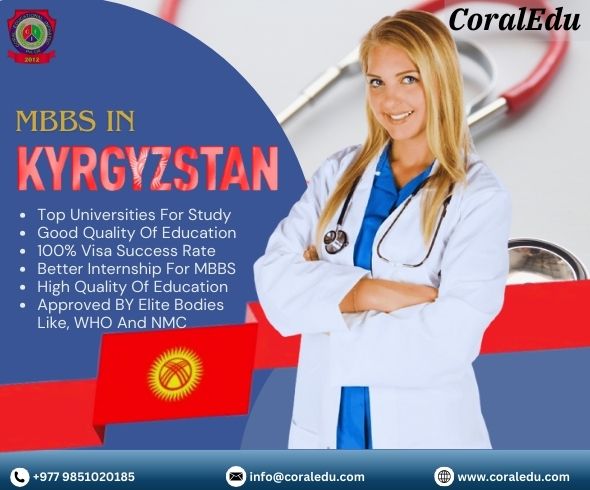
Kyrgyzstan is an excellent and prudent choice for pursuing an MBBS degree, as it offers globally recognized medical degrees at highly affordable rates. The total cost of the entire six-year course (including both tuition fees and hostel accommodation expenses) ranges from ₹15 lakhs to ₹25 lakhs—which is significantly more affordable compared to private medical colleges in India—and securing admission here requires no payment of any kind of hidden donation fees. The entire curriculum is taught entirely in English, and the universities here are fully recognized by top medical bodies such as the World Health Organization (WHO) and the National Medical Commission (NMC).
1. Official Name: The Kyrgyz Republic
2. Capital City: Bishkek (located in the northern part of the country near the border with Kazakhstan).
3. Area: Approximately 200,105 square kilometres (about 77,261 square miles).
4. Population: Estimated at 7.4 million people.
5. Currency: Kyrgyzstani Som
6. Languages: Kyrgyz, Russian
7. Economy: Kyrgyzstan ranks 124th in the world by nominal GDP, with an estimated total GDP of $23.61 billion.
1. Low Tuition Fees: The cost of studying (especially for degrees like MBBS) is significantly lower than in private institutions in countries like India, making quality education accessible.
2. Affordable Cost of Living: Living expenses range between $400 to $800 per month, which is highly economical for middle-class families compared to Western European countries.
3. No Capitation or Donation Fees: Admissions are largely based on merit and basic eligibility, requiring no hidden donations or massive capitation fees.
4. Budget-Friendly Travel: Located relatively close to South Asia, travel to and from Kyrgyzstan is quick and inexpensive, allowing students to visit home during holidays.
5. Globally Recognized Degrees: Degrees are accredited and recognized by top global health and education councils, including the National Medical Commission (NMC), World Health Organization (WHO), and FAIMER.
6. English-Taught Programs: Many universities offer courses entirely in English, completely eliminating language barriers for international students.
7. No Mandatory Entrance Exams: Unlike the intense competition in many home countries, you do not need to clear strict domestic entrance exams (like NEET in India) just to secure a seat.
8. Focus on Practical Learning: Universities heavily emphasize practical clinical rounds, laboratory work, and hands-on training to ensure career readiness.
9. Prep for Licensing Exams: Many top medical institutions offer in-built coaching for licensing and screening tests such as the FMGE, USMLE, and PLAB.
10. Safe and Welcoming Environment: The country, especially around major university cities like Bishkek, is known for being safe, secure, and student-friendly with 24/7 campus and hostel security.
11. Large International Community: With thousands of international students already studying there, you will find a supportive and thriving expat community (e.g., strong Indian student networks).
12. Availability of Home Foods: Major cities host numerous Indian restaurants and supermarkets, and university hostels frequently offer customized vegetarian and non-vegetarian food options.
13. Rich Cultural Exposure: Studying at the crossroads of Central Asia allows you to experience a unique, diverse blend of cultures and breathtaking natural landscapes.
14. Global Career Opportunities: Earning an internationally accredited degree prepares you to practice or pursue further studies in Europe, the US, Canada, Australia, or your home country.
15. Multicultural Networking: Interacting with peers and faculty from all around the globe helps you build a strong international professional network.
Feature | Details |
Intake | October |
Score Required in 10+2 | 50% in PCB |
NEET Requirement | YES |
Fees Structure | 3500 – 6500 USD Per Year |
Hostel | 200 to 260 USD Per Month |
Duration | 5 Years |
Medium of Instruction | English |
Top Medical University | Kyrgyz Russian Slavic University |
Recognition | NMC and WHO approved |
1 | General category candidates need a minimum of 50% marks in the 10+2 examination. |
2 | Must have passed the 10+2 (or equivalent) examination with Physics, Chemistry, and Biology as core subjects. |
3 | Reserved category students (SC/ST/OBC) may be eligible with 40% marks. |
| 4 | Qualifying the NEET (National Eligibility cum Entrance Test) is mandatory for admission to MBBS programs in Kyrgyzstan. |
5 | The minimum age requirement is 17 years, as of December 31st of the year of admission. |
6 | Must have completed 12th from a recognized board or equivalent institution. |
1. International higher school of medicine
2. Kyrgyz State Medical Academy
3. Jalalabad State University
4. Asian Medical Institute, Kyrgyzstan
5. Kyrgyz-Russian Slavic University
6. Osh State University
7. Kyrgyz National University
8. Osh State Medical University
9. Jalalabad State Medical University
10. Ala-Too International University
University | Annual Tuition (INR) | Hostel & Maintenance (INR) | |
| Osh State Medical University | ₹3.50 Lakhs – ₹4.00 Lakhs | ₹50,000 – ₹60,000 | |
Kyrgyz State Medical Academy | ₹4.50 Lakhs – ₹5.00 Lakhs | ₹60,000 – ₹75,000 | |
International School of Medicine | ₹5.00 Lakhs – ₹5.60 Lakhs | ₹50,000 – ₹60,000 | |
Asian Medical Institute | ₹2.80 Lakhs – ₹3.50 Lakhs | ₹50,000 – ₹56,000 | |
| Bishkek International Medical Institute | ₹3.00 Lakhs – ₹3.50 Lakhs | ₹50,000 – ₹60,000 |
Step-by-Step Admission Process
1. University Selection: Research and shortlist accredited medical universities (such as Kyrgyz State Medical University or Osh State Medical University).
2. Document Submission: Complete the application form on the chosen university’s website and submit scanned copies of your 10th and 12 th mark sheets, valid passport, and NEET scorecard.
3. Admission Letter: The University will issue an admission letter after verifying your academic credentials (usually takes 7–15 days).
4. Invitation Letter: Submit your passport details to the university to receive the official Ministry-approved invitation letter, which is needed for your visa.
5. Student Visa: Use the invitation letter, admission letter, and required original documents to apply for a student visa at the Kyrgyzstan Embassy.
6. Travel and Enrollment: Once your visa is stamped, book your flight to Bishkek. University representatives usually assist with airport pickups, hostel allocation, and medical checkups upon arrival.
So.No. | Description |
| |
1. | Valid Passport (at least 1-year validity) |
2. | 10th and 12th mark sheets and passing certificates |
3. | NEET scorecard |
4. | Passport-sized photographs |
5. | Birth Certificate |
6. | Medical Fitness Certificate (including HIV test report) |
7. | Bank statement from parents/guardians showing sufficient funds |
|
|
|
Year | Phase | Core Subjects |
1st Year | Pre-Clinical | Human Anatomy, Histology, Cytology, General Biology, Chemistry, Medical Psychology, and Basic Russian/Kyrgyz language. |
2nd Year | Pre-Clinical | Anatomy (Advanced), Physiology, Biochemistry, Microbiology, and fundamentals of Patient Care. |
3rd Year | Pre-Clinical | Pathology, Pharmacology, Forensic Medicine, Radiology, Embryology, and early clinical observations (E.N.T., Ophthalmology). |
4th Year | Clinical | Internal Medicine, Surgery, Community Medicine, Pediatrics, Obstetrics & Gynecology, and Infectious Diseases. |
5th Year | Clinical | Intensive clinical training in specialized areas like Oncology, Traumatology, Neurology, Dermatology, and Psychiatry. |
6th Year | Internship | Mandatory rotational internship involving practical training in Medicine, Surgery, OBG, Pediatrics, and Emergency care. |
While Kyrgyzstan does not offer centralized 100% government-funded scholarships for international students, you can access numerous merit-based fee waivers and NGO scholarships. Typically, top medical institutions and charitable organizations offer around 3 to 5 major, readily accessible scholarship schemes that can reduce your financial burden by up to $3,000 per year.
Top Scholarship Schemes
The top 10 career opportunities available after your degree include:
1. Licensed General Practitioner (GP)
2. Postgraduate Specialist (MD/MS/Residency)
3. Clinical Research Associate
4. Hospital & Healthcare Administrator
5. Medical Writer / Content Specialist
6. Pharmaceutical Advisor / Drug Safety Specialist
7. Healthcare Consultant
8. Academic Lecturer / Medical Educator
9. Medical Representative (MR)
10. NGO / Public Health Worker
If you remain in Kyrgyzstan, you will need to clear local licensing and ideally possess basic proficiency in Russian or Kyrgyz to work comfortably with patients.
1. Public Sector (e.g., Bishkek hospitals): 28,000 to 55,000 Kyrgyz Som (KGS) per month (approx. ₹24,000 to ₹47,000/month).
2. Private Clinics: 70,000 to 150,000 KGS per month (approx. ₹60,000 to ₹1.3 Lakh/month).
Lifestyle in Kyrgyzstan is considered very good because it offers a peaceful, affordable, and healthy life surrounded by beautiful nature. People enjoy a relaxed daily routine with very little stress compared to giant global cities. The air is fresh, the mountain water is clean, and the food is natural and healthy, featuring fresh dairy and organic meats. It is also a safe country with highly affordable housing, transportation, and groceries. Most importantly, the strong community culture and warm hospitality mean that neighbors always help each other, making life feel safe, welcoming, and connected.
By providing comprehensive support services, CoralEdu aims to make the process of studying MBBS in Kyrgyzstan smoother and more manageable for students, ensuring a successful academic journey abroad.
can help – fill in your details and we’ll call you back.